Persistent low birth rates in the United States and other high-income countries are puzzling policymakers and demographers, especially as the two-child “ideal” endures.1 Examining fertility decision-making, four recent studies suggest that whether people actually have children is less about wanting kids in the long term and more about perceiving the right circumstances and feeling ready in the short term.
Collectively, these studies highlight four reasons why today’s birth rates are falling short of people’s childbearing goals:
- Given life circumstances and other barriers, desires for children and actions do not always align;
- Uncertainty about realizing childbearing goals is on the rise, particularly among young and childless people;
- Economic and relationship worries are causing some people to avoid pregnancy in the immediate future; and
- Stress from the COVID-19 pandemic changed people’s timing for having children.
Overall, decisions about having children are heavily shaped by uncertainty, stress, and perceptions of the future. Rising unease about the state of the world—and what comes next—is making people less confident in their plans to start and grow families. As long as uncertainty about the future and barriers to achieving goals remain high, fertility rates are likely to continue to decline, these findings suggest.
The Desires-Intentions Gap
The terms fertility desires—wishes to have children—and fertility intentions—actual plans to have children—are often used interchangeably, but they capture different dimensions of fertility decision-making. The desires-intentions gap may help explain why fertility rates continue to fall even as the number of kids people want to have has remained overall stable.
Key Terms in Fertility Decision-MakingDesires: whether people want to have (or not have) children. Intentions: whether people have a concrete plan to have (or not have) children. Desires-intentions gap: the mismatch between wanting a child and planning to have one, often due to social, economic, or health barriers. Uncertainty (general): instability or unpredictability in social, economic, or relational conditions that complicates fertility decision-making. Economic uncertainty: financial insecurity or pessimism about future economic conditions that reduces readiness for childbearing. Relationship uncertainty: doubts about forming or maintaining a stable partnership, influencing decisions to postpone or avoid childbearing. Goal uncertainty: difficulty forming clear fertility goals, expressed through responses such as “don’t know” regarding childbearing plans. Intensity of goals: the strength of commitment or emotional importance attached to achieving one’s fertility goals. Pregnancy avoidance: the degree to which avoiding pregnancy is important right now, often driven by stressors or uncertainty. Fertility postponement: delaying childbearing, often because current circumstances do not align with desired conditions for having children. |
To identify predictors of this gap, Luca Badolato at The Ohio State University analyzed 2011–2018 data from the National Survey of Family Growth (NSFG), a comprehensive, nationally representative survey of over 42,000 Americans ages 15 to 49.2 The study found that people’s desires and intentions fall into four categories: (1) desire and intend to have children; (2) desire but do not intend to have children; (3) do not desire but intend to have children; (4) do not desire and do not intend to have children. The desires-intentions gap generally applies to people in the second category, who want kids but don’t actually plan to have them; the third category, where people don’t want children but plan to have them, is quite rare.
In 2018, about 4% to 6% of respondents fell into the desires-intentions gap (including sterilized respondents raises this figure to 9%). The gap widens with age: It is minimal among respondents ages 25 to 29, but significant among those ages 45 to 49, where up to 56% of women and 41% of men desire a child or more children without intending to have them. People without children tend to have smaller desires-intentions gaps than those with children, and people with a larger number of children tend to have larger gaps. Women are more likely to experience the desires-intentions gap, likely reflecting biological and social constraints, including the social stigma around infertility.3
These results suggest that fertility rates are, in part, falling not because people want fewer children, but because they can’t meet their goals to have them due to external constraints, especially at older ages. The gap suggests high levels of unrealized fertility and highlights barriers—including age, gender norms, partnership stability, financial insecurity, health concerns, and infertility—that prevent people from acting on their goals. As childbearing continues to be postponed to later ages, the desires-intentions gap might increase among American adults.
Multiple Dimensions of Uncertainty
Uncertainty in the world may lead to uncertainty in fertility plans. In another study, Badolato, with colleagues Sarah Hayford (Ohio State University) and Karen Benjamin Guzzo (University of North Carolina at Chapel Hill), analyzed three dimensions of uncertainty in fertility planning: goal uncertainty, realization uncertainty, and intensity of intentions. They documented trends in these dimensions among U.S. women ages 15 to 44 using NSFG data from 2002 to 2019.4
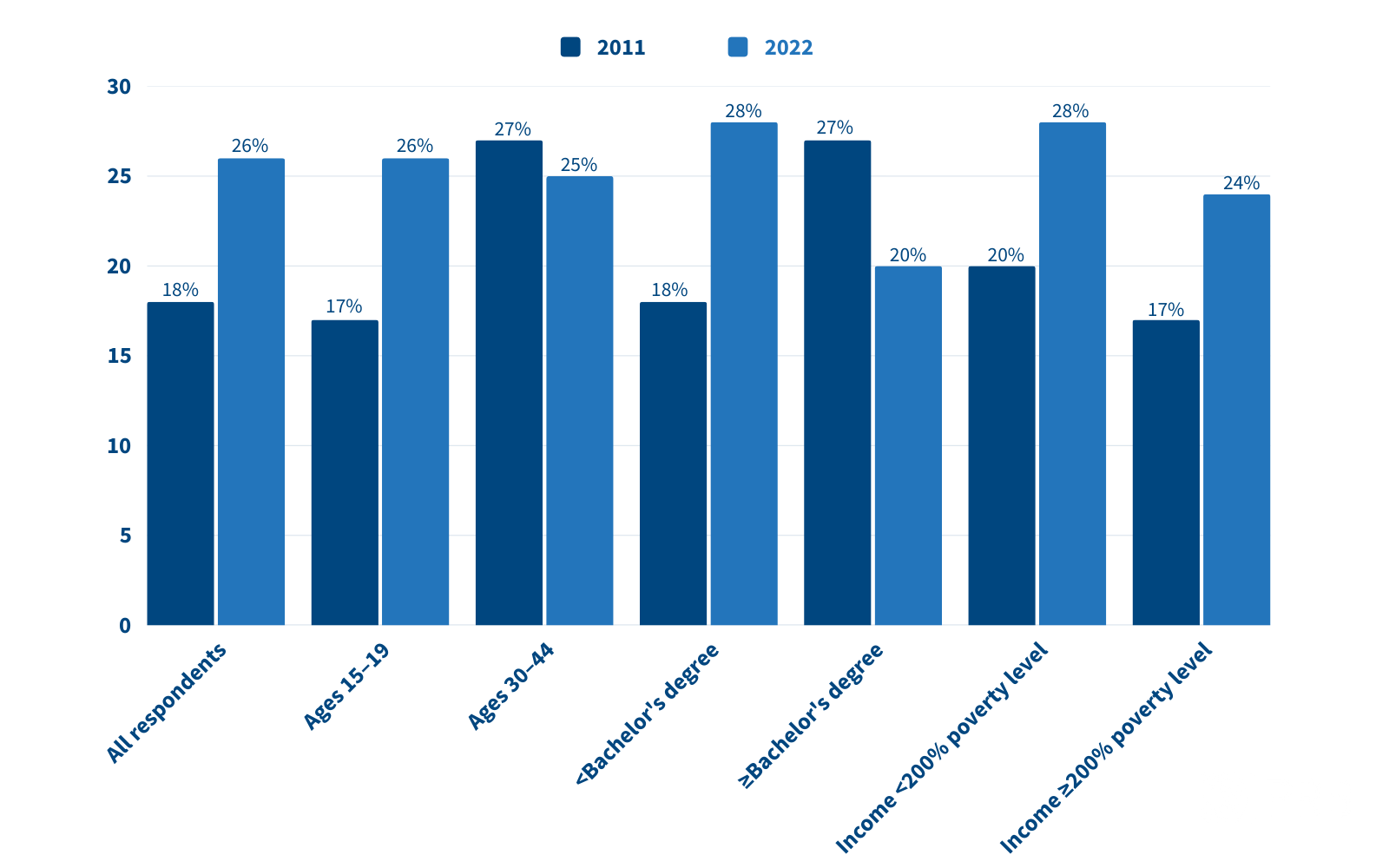
The study found that goal uncertainty—or being unsure of one’s fertility goals—is rare and relatively stable over time, reported by 1.5% to 2.1% of respondents. However, realization uncertainty—having doubts about whether one can achieve their fertility goals—is widespread: Up to 50% of women who intend to have at least one (more) child express doubts about whether they will actually do so. Further, low intensity of intentions—how strongly people feel about their goals—shows an increase: Among childless women intending to have children, the share who said they “would not be bothered if they did not have a child” rose from 18% in 2002 to 26% in 2018, driven by young women ages 15 to 29. For instance, while low intensity remained overall stable among women without children ages 30 to 44, 27% in 2002 and 25% in 2018, it increased 9 percentage points among their peers ages 15 to 29, from 17% in 2002 to 26% in 2018 (see Figure 1).
Figure 1. Trends in Fertility Intentions: Intensity
Share of women who want children but do not yet have them who said they would be “not at all bothered or a little bothered” if they wound up not having children
Source: Luca Badolato, Sarah R. Hayford, and Karen Benjamin Guzzo, “Multiple Dimensions of Uncertainty in Fertility Goals: Recent Trends and Patterns in the United States,” Genus 81 (2025): 14.
These dimensions of uncertainty have an impact on fertility levels, the researchers found. Women with greater certainty and stronger intensity tend to plan for more children and intend births in a shorter timeframe, while those with high uncertainty or weak intensity are more likely to postpone childbearing or decide on fewer children. Women with more education and higher incomes tend to have higher certainty and stronger intensity, though this group also saw declines in recent years.
Perceptions of the Future and Pregnancy Avoidance
A person’s fertility behavior is influenced not only by their socioeconomic status but also by how they perceive their future. In another study, Guzzo and colleagues Anna Belykh, Wendy Manning, Monica Longmore, Peggy Giordano, and Sara Roza, all at Bowling Green State University (BGSU), further drilled down on the question of why fertility rates are dropping despite the two-child ideal, examining how an individual’s subjective perceptions of their future might shape their attitudes around avoiding pregnancy.5
The researchers drew from the Toledo Adolescent Relationships Study—a longitudinal project led by researchers at BGSU—and focused on data collected between April 2018 and March 2020, when respondents were ages 29 to 36. They found that adults who were pessimistic about their financial future were significantly more likely to say it was “very important” to avoid pregnancy in the short term than those with a more positive financial outlook. This link persists even when accounting for objective socioeconomic conditions, such as education, income, and employment.
Uncertainty about whether a current relationship will last was also strongly associated with heightened pregnancy avoidance. People who felt less sure about their relationship more often felt it was important to avoid getting pregnant in the immediate future, regardless of whether they’re married or living with someone.
These findings emphasize the complex nature of predicting family planning decisions, which hinge not just on reality but expectation. Further, people are postponing having children over longer periods, meaning that instability—real or anticipated—may raise the risk of never having children at all.
Pandemic Stress and Fertility Timing
Uncertainty and stress during the COVID-19 pandemic may have pushed more people to wait to have kids. Early in the pandemic, U.S. fertility rates dipped, prompting researchers to explore why. Wendy Manning with colleagues Guzzo, Claire Kemp Dush at University of Minnesota, and Gabrielle Juteau at BGSU used the National Couples’ Health and Time Study, a nationally representative survey of married or cohabiting 20- to 50-year-olds from September 2020 to April 2021, to examine the association between pandemic-related stressors and fertility intentions. Focusing on respondents who either wanted children or remained open to (more) children, the researchers looked at rationales for delaying fertility and the effects of external stressors.6
The study found that respondents who experienced greater pandemic disruptions or relationship stress were less likely to intend to have a child in the next year, leading to short-term fertility delays. Among those delaying fertility, the top rationale was economic concerns, followed by health worries and uncertainty about the future (Figure 2). Stress about the economy and health remained predictors of delay even when accounting for objective indicators like income, employment, and health.
Figure 2. Reasons People Who Want Kids Are Avoiding Having Them
Average scoring of reasons for not having children within the next year
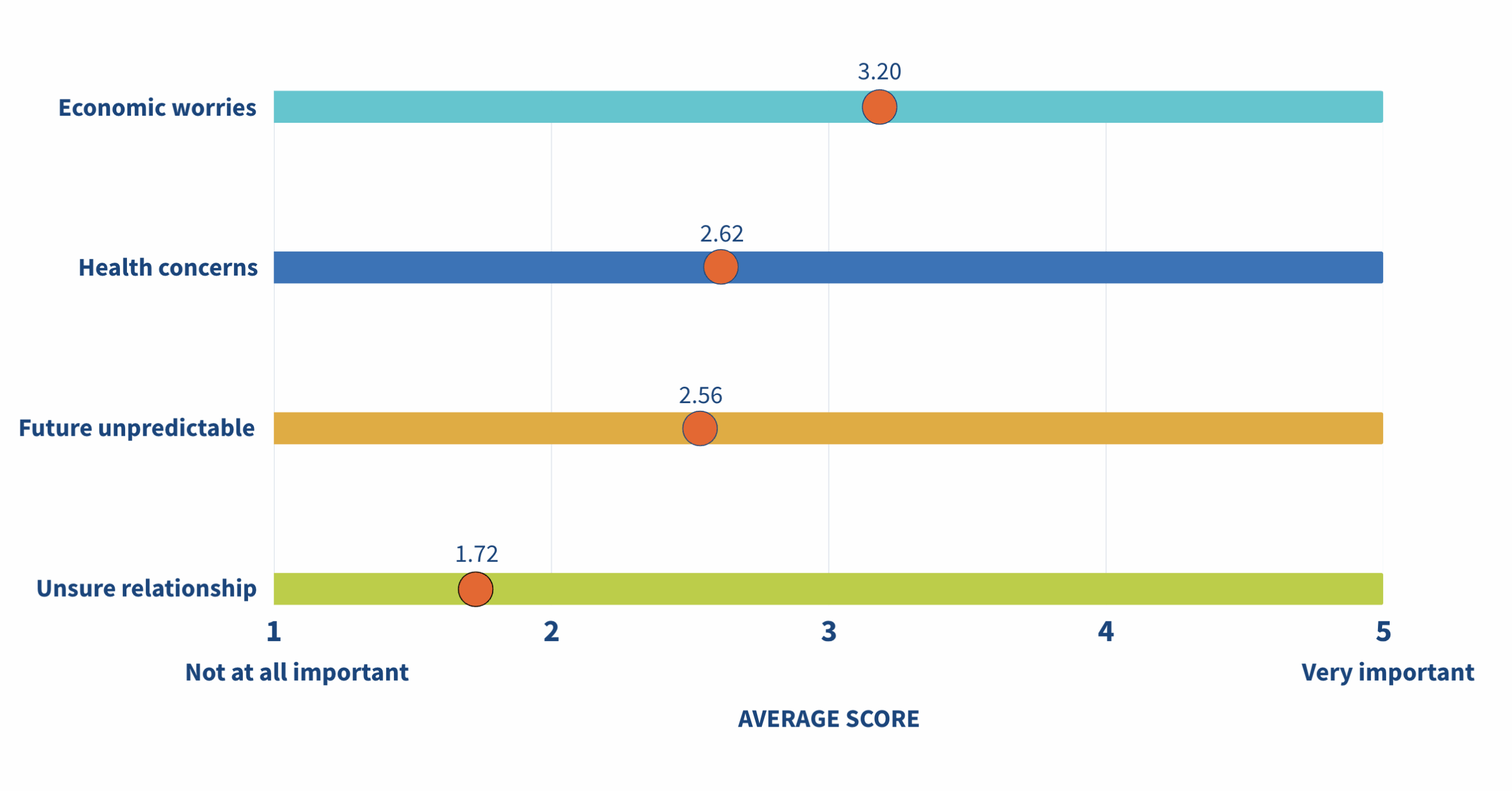
Notes: Respondents who wanted children or remained open to having children but were not intending to have children within the next year scored these reasons for wanting to avoid having children in the short term from 1 (“not at all important”) to 5 (“very important”). Data are from the National Couples’ Health and Time Study, a nationally representative survey of married or cohabiting 20- to 50-year-olds from September 2020 to April 2021.
Source: Wendy D. Manning et al., “Pandemic-Based Stress and Timing of Fertility Intentions Among Partnered Adults,” Socius: Sociological Research for a Dynamic World 11 (2025).
These findings provide further support for arguments about the importance of individual perceptions in fertility decision-making, underscoring that fertility timing decisions are heavily impacted by subjective stressors, not just objective conditions. Still, initial declines in fertility observed at the onset of the pandemic will not necessarily endure. Acute crises intensify the impact of uncertainty on fertility, revealing the fragility of people’s intentions and pushing childbearing further into the future.
Policies Should Focus on Reducing Feelings of Uncertainty
These new findings suggest that fertility decline at least partially reflects delay rooted in uncertainty and constraints, rather than a wholesale rejection of childbearing. The increasing precarity of daily life means that parenthood is often postponed because the “right time” feels elusive. Repeated postponements can then compound into long-term fertility decline.
Policies that address only the economic barriers to having children—such as child tax credits and subsidized childcare—likely miss important subjective dimensions of the issue. As policymakers craft responses to decreasing fertility, programs and policies must consider how people are feeling about their lives and their futures, including their perceptions of financial security, relationship stability, and confidence in achieving goals.
Fertility decline in the United States may best be framed as a growing gap between what people say they want, what they actually plan to do, and what they can achieve, shaped in part by increasing uncertainty rather than waning parenthood aspirations, as these studies suggest. Financial incentives alone may not close the gap, but policies that help Americans feel more confident about the future—promoting childcare availability, stable housing, job security, and health coverage—could be a key part of the solution.
This article was produced under a grant from the Eunice Kennedy Shriver National Institute of Child Health and Human Development (NICHD). The work of researchers from the following NICHD-funded Population Dynamics Research Centers was highlighted: Bowling Green State University, Ohio State University, University of North Carolina at Chapel Hill, and University of Minnesota.